Simple just works: how i built puddleswap
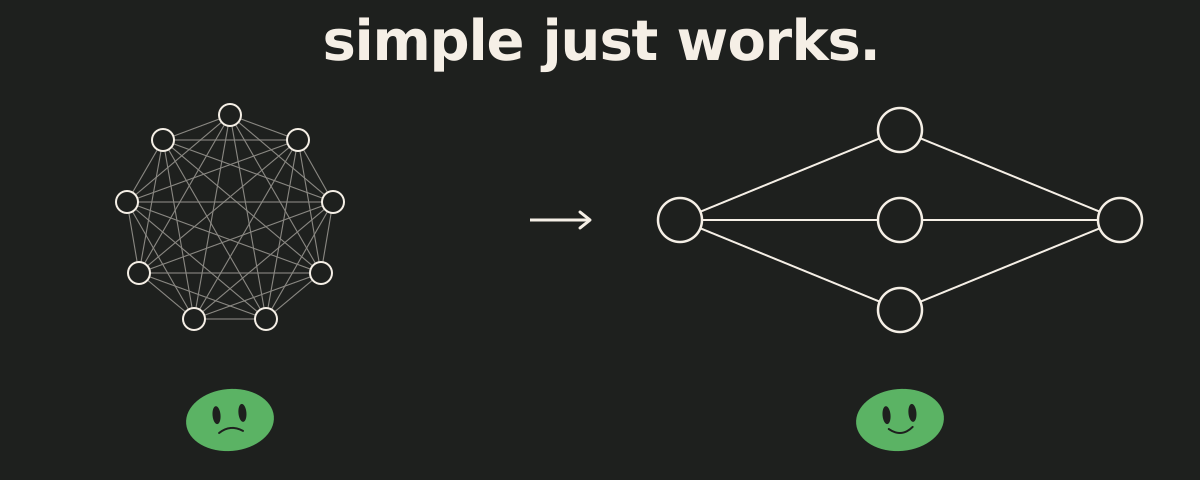
Any problem yields to enough complexity.
Most of puddleswap was built by an AI agent, and that is most of why I want to talk about it. An agent reaches for the textbook answer by default, because the textbook is what it read. Engineers do the same, since most of us meet the general case years before we ever meet the specific one. The work that’s left for a human is catching the moment a clever solution is solving a problem you don’t actually have. I almost missed that moment on the routing. Here’s how that went, plus the gut-check I run now before writing anything clever. If you ever feel yourself overengineering things, this is for you.
I was at a Monad Blitz event, if I am not mistaken it was the one in Ankara, and I was watching everyone around me hack on cool stuff while I sat in the corner answering their questions. I mean that’s my job but it felt weird not building stuff while everyone else is trying their best.
So at some point I figured I should just build something(while not ignoring people at the same time lol). Something simple enough that the brag would be how little it took.
That’s how puddleswap happened. A testnet dex on Monad testnet
Going in, I wanted the fewest moving parts I could get away with. The thing I’d be most proud of would be how little there was to maintain. (If possible, i wanted nothing to maintain at all.)
The agent did the bulk of it. It wrote the React frontend and deployed the contracts; the swap UI came together as it went. The contracts are stock Uniswap V2, audited a thousand times over the years(centuries in web3). The frontend is Vite + React with no backend. The swap accepts real Circle USDC, a mock USDT we deployed for testnet liquidity, and WMON. A small rebalancer service on railway keeps the price pegs roughly honest.
It’s live at app.puddleswap.org.
The build was mostly uneventful. The agent did its thing, I reviewed diffs, we iterated. What I want to talk about is the one decision I almost got wrong: the routing.
The thing I almost overengineered
Standard answer for “how does a DEX UI route swaps” is a graph algorithm. You have N tokens and M pools, build the liquidity graph, run shortest-path weighted by output amount, return the best route. 1inch and Matcha both work this way and every aggregator article online tells you to do the same, so I started writing it.
Then I looked at my actual data.
Three “core” tokens: USDC, USDT, WMON. Maybe ten pools, every one of them touching at least one core. I was writing a graph algorithm to solve a problem I didn’t have.
The gut-check is dumber than it sounds: look at your actual data before you pick the algorithm, and count the inputs while you’re in there. I had three hubs and ten pools. I was about to write code for a scale I would never see.
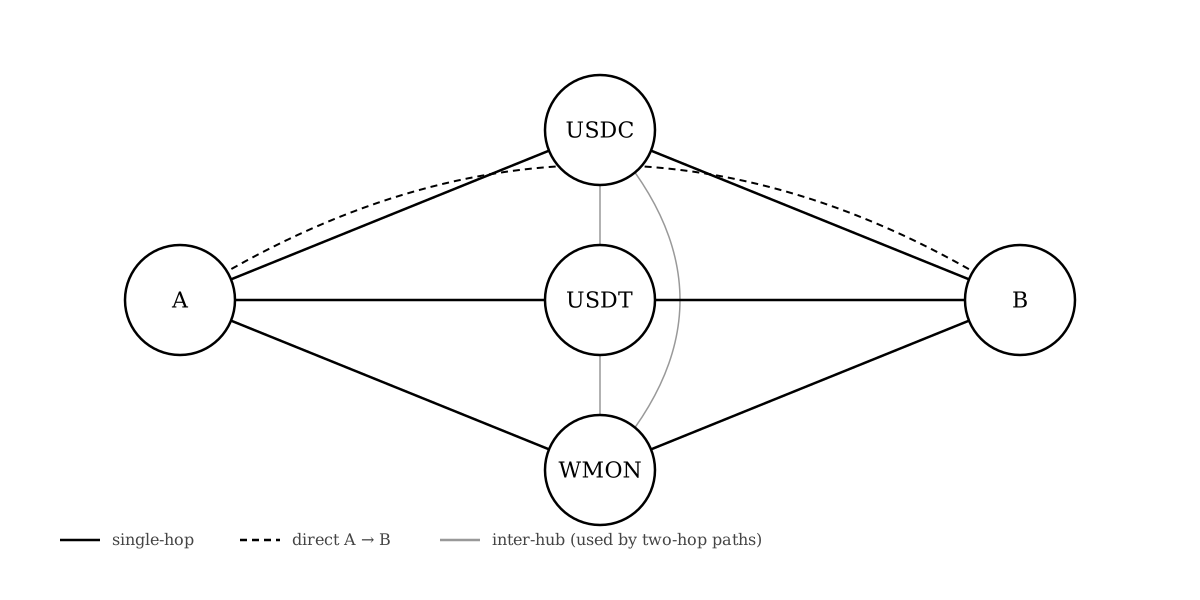
So I deleted it and wrote the following instead (s/o to @danielvf for the idea + the initial PRD).
The enumeration
For any swap A → B, enumerate every plausible route through the hubs:
- Direct:
A → B - Through one hub:
A → USDC → B,A → USDT → B,A → WMON → B - Through two hubs:
A → USDC → USDT → B,A → USDC → WMON → B,A → USDT → WMON → B, and reverses
That’s at most ten candidate paths. Send all ten quote requests in one multicall, pick the path with the highest output, swap on that.
const routes = buildCandidateRoutes(tokenIn, tokenOut, cores);

const results = await publicClient.multicall({
  contracts: routes.map((path) => ({
    address: router,
    abi: routerAbi,
    functionName: "getAmountsOut",
    args: [amountIn, path],
  })),
  allowFailure: true,
});

const best = selectBestQuote(results);
The whole router is around 50 lines. It builds the candidate list (deduped) and returns whichever path the multicall said had the highest quote.
The agent will hand you the general solution
I’m not saying graph routing is wrong. For a mainnet aggregator routing across thousands of pools and dozens of DEXes, it’s the right tool. But I wasn’t building that.
The old lesson was: “a lot of code over-solves the problem.”
You see it everywhere once you start looking. A sorting algorithm where the data is always ten items or fewer, when plain insertion sort would have done. A caching layer sitting in front of a database that gets hit twice a day, as if the database weren’t already a cache. Or my favorite, pub/sub wired up for exactly one publisher and one subscriber, where you could have called the function. Another example you might have noticed is claude suggesting using redis for caching instead of using a simple in-memory cache for tiny apps that would not get restarted enough times to justify it.
That redis suggestion is the tell, and it’s worth sitting with. The smart-looking solution is usually the general problem dressed up, and there are now two reasons it ends up in your editor. An engineer reaches for it because the general case is what they studied, and because the small version doesn’t look like much (nobody brags about an insertion sort). An agent reaches for it because the general case is most of what it read. “Trained on” is literal for the agent and a figure of speech for the human, and the two of you ship the same overbuilt code.
And the new problem we are facing is that the interesting work has shifted from writing the solution to spotting the constraint. The agent can write the graph router faster than I can, and it will, unless I hand it the shape of what I actually have. On puddleswap that shape is:
- One chain, one DEX
- Three hub tokens I control (or my agent controls)
- Operator-maintained liquidity
- UI being so simple that my grandma can use it(rip grandma)
Give it those four lines and enumeration falls out on its own. Within those constraints it’s correct (every meaningful route gets checked) and faster than graph traversal, since it’s one batched RPC instead of N round-trips. It’s also a fraction of the code.
When this breaks
I’d be lying if I said this scales. The enumeration is correct because of one invariant I quietly lean on: every pool touches a core token, so every route worth taking runs through a hub. The failure modes are all just that invariant giving way:
- Exotic-to-exotic pools that bypass the hubs entirely. Enumeration misses them.
- A hub runs dry of liquidity on one side. Router still checks routes through it and eats a bad quote.
The day that invariant stops holding is the day I bother writing the graph router. (it’ll probably do fine as it is right now)
The end
If you’re building on Monad testnet and need swaps for your tests, puddleswap is live at app.puddleswap.org. The router is at puddleswap/web/src/lib/routing.ts.
So before you accept the clever thing your agent just wrote, do the part it won’t do for you: look at your actual data and ask whether a smaller solution already covers it, because it usually does. And ask the agent for the simpler version out loud, since it won’t offer one on its own.
Related: How to find ideas worth building - the same heuristic applied to a different problem.
Questions?